Tag: image

  • XnConvert: Freeware Image Manipulation

    XnConvert (Version: 1.51), from the maker of the excellent image editor and viewer XnView, is a freeware multi-platform batch image converter for Windows, Mac and Linux.
    XnConvert

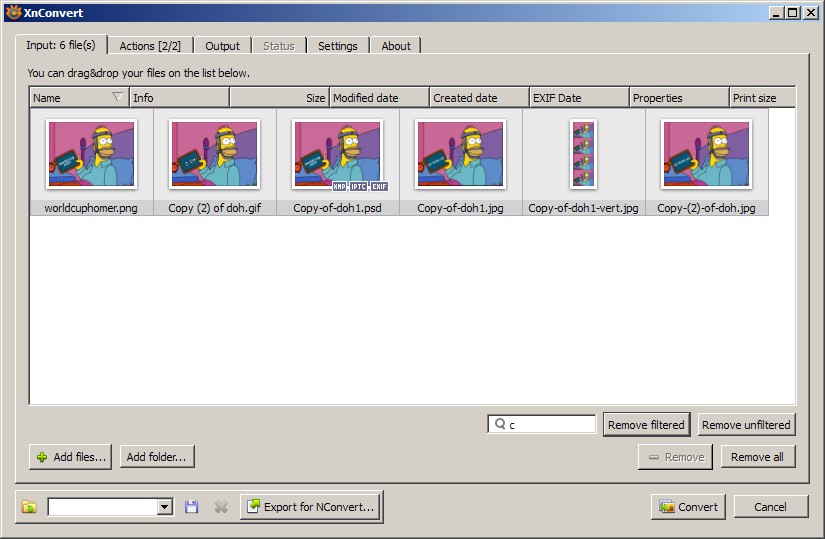
    Input or load file(s)/folder(s) and then if necessary filter the images to only work on a set of them.

    Next is the Actions tab, choose modifications or conversions required and see a preview on the right hand side. The actions available via the Add Actions button are extensive and are Add mask, Automatic crop, Canvas resize, Change color depth, Clean metadata, Crop, Extract channel, ICC convert, IPTC/XMP, Mirror, Replace color, Resize, Rotate, Set DPI, Text, Vignetting, Watermark, Adjust, Align histogram, Automatic contrast, Automatic levels, Color balance, Conbright, Equalize, Exposure, Gammasat, HLS, Levels, Logarithmic lut, Negative, Normalize, Normalize ex, Posterize, Saturation, Sepia, Shadow highlight, Solarize, Swap component, Temperature. Available filters are Average, Blur, Edge detect, Emboss, Emboss more, Enhance detail, Enhance edges, Enhance focus, Focus restoration, Gaussian blur, Maximum, Median box, Median cross, Minimum, Reduce noise, Sharpen and Soften. Others included are Add noise, Bloom, Border, Border 3-D, Crystallize, De-interlace, Fantasy, Halftone, Lens, Mosaic, Oil painting, Oil painting 2, Old camera, Photo spread, Pointillize, Retro, Shear, Slice, Spread, Swirl, Symmetry, Tile and Waves.

    XnConvert

    The output section has settings for choosing the output folder, format and an extensive number of options for renaming the image files. Everything from date to folder to increments and metadata can be selected and configured. XnConvert can delete the originals, keep any folder structures and keep multi-page files as multi-page and open windows explorer after conversion is complete.

    XnConvert

    XnConvert is complete and very easy to use, much like XnView itself actions can be saved as a script for future re-use. Both 32-bit and 64-bit editions are available as are installer and portable versions.

  • Alternate Pic View: Freeware Image Tool

    Alternate Pic View (Version: 1.424) is an image viewer and editor. It has features common to most image viewers. By default the Folder view (show thumbnails and explorer tree) and Allow multiple windows (view images in tabs) are toggled off or disabled. Click their respective icons to enable them (see image).

    Alternate Pic View

    Alternate Pic View does full screen capture (File—>Capture) and another more advanced method via its Tools menu called Capturer. Here all open windows are listed and the user can choose which to capture (see image). Under Tools there is a convertor and icon extractor as well. The former can convert to any one of bmp, gif, ico, tiff and others with any of resize, keep metadata, mirror, flip, swap colors, pixelize, sharpen, grayscale and alien effect.

    Alternate Pic View can resave image by adding increments, for example if image.jpg is open repeatedly clicking File—>Save numbered (F7) will save the image as image__0000.jpg, image__0001.jpg, etc. Copy, crop and paste operation are available, for both whole images and selections. Its collection of effects are rotate, mirror, invert alpha, sharpen, blur, contrast/brightness, adjust color, noisify, pixelize, relief, negative, grayscale, redeye reduction, swap colors, alien effect and random. Using the effects menu one can change the image size, extend the canvas size or more unusually split an image – either by image coordinates or by selection area.

    Alternate Pic View can also work straight from a scanner with Twain source and it can also do slideshows. In some instances Alternate Pic View is not the most intuitive. Two features only become apparent only when an image is right clicked in the thumbnail area. First there is an image compare feature which compares two images but it is not obvious how the second one can be chosen or if it works at all. Second there is the animated gif feature which again doesn’t seem to do anything other than let the user click forward or rewind to view each individual frame.

    On the editing side it has color picker, pen, pencil, brush, line, arrow, fill, brush, rectangle, round rectangle, ellipse and freehand. Of note is that Edit—>Find pictures will scan a folder for image files. Alternate Pic View should works on all Windows versions.

  • Copy Contents: Fast Copy And Text Replacement

    Note: Copy Contents is in beta. Correction made to a screenshot that appeared earlier.

    Copy Contents is a new program. It copies the contents of text or rtf files to the clipboard without opening them. It also copies image files (jpg, bmp, gif, tga, png, tif, pcx) to the clipboard, also without opening them. Right click on the supported formats mentioned and choose Copy Contents, the (successful) copied message appears briefly on the screen, now open a blank file (either text or image) and Ctrl+V to paste.

    Copy Contents

    Copy Contents does (plain) text replacements to make better and more efficient use of the copied text. Click Ctrl while clicking on Copy Contents and set up or use text replacements. It comes with three default macros in #date#, #time# and #ask#:<default text>. If a text files written for repeated use has [[date]] and [[time]] in it they will replaced with the current date and time when pasted. The third macro generates a dialog window and the text in between < and > will be replaced with the word entered in the ‘Replace with’ box.

    Copy Contents
    Copy Contents can be set to always ask for replacements, use the included ones without prompt or not use them at all. The OFF setting can be overridden on a case by case basis by holding the Shift key when clicking on Copy Contents in the right click context menu. Copy Contents is by http://starpunch.net/ and is currently available at the DonationCoder forums.

  • LazPaint: Open Source Graphics Editor

    LazPaint (Version: 4.8) is open source and is a good and very capable alternative to any full featured image or graphics editors. Some of its features are listed below using its menu as a reference and the images attached to this review highlight a few of them.

    LazPaint

    LazPaint can do multiple undo and redos and paste as and paste as new image. Selections are available as rectangle, ellipse and polygon, these are complemented with curve that can create complex shapes or areas based on initial and end points. Selections can be edited, rotated and there is also the magic wand to automatically select objects within an image. Change canvas size and flip are available too as is zoom which includes a ‘Smart zoom’.

    LazPaint
    Shift colors (Colors—>Shift colors) and Deformation (Tool—>Deformation)

    Colorize and shift colors work really well and change an image smartly. Intensity, lightness, normalize, negative, linear negative and grayscale are equal or superior to other similar programs. Pen, color picker, eraser, gradient, fill, shaded shape (many available shapes with adjustable light sources), text, deformation (image is divided into any number of grids and then any section of the grid can be dragged to distort portion(s) of an image) and texture mapping take LazPaint into more advanced territory.

    Filter are mostly the common ones with different blurs (radial, motion, disk, fast, precise), sharpen, smooth, pixelate, cleartype, contour and emboss all there plus plane. The latter comes with a warning that it is a slow process (see last image for what the first image image is transformed into using plane). Finally render adds any one of various objects over a selection or the whole image.

    LazPaint
    Plane (Filter —>Plane)

    LazPaint is multi-platform written in Lazarus, has command line support and so can take advantage of the BGRABitmap library, read more at http://wiki.lazarus.freepascal.org/LazPaint and http://wiki.freepascal.org/BGRABitmap. Input file formats supported are bmp, jpg, png, gif, ico and Paint.NET’s pdn and it can save to bmp, png and jpg.

    Image in the screen shots is at http://www.flickr.com/photos/puksdesign/5896307147/in/photostream

  • Freeware No Frills Clipboard Manager: anyClipboard

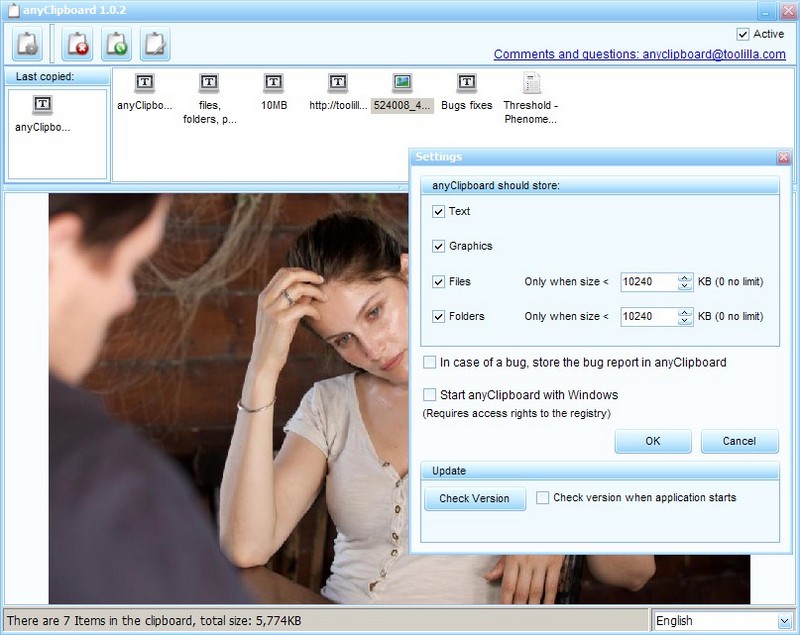
    anyClipboard (Version: 1.0.2) is a single executable, no install clipboard manager. It is virtually featureless and does one thing only. It helps the user keep copies of all clipboard items in the order they were captured. It captures everything – though one can disable captures by file type – be they files, folders, photos or text (with the promise of more to come).

    anyClipboard

    The program’s settings are accessed by right clicking the program’s tray icon. Since it copies everything to its data folder, created after first run, it can become large quickly. It does warn if the to be captured file is larger than 10MB and at that point it can be set to not create a copy of files larger than 10MB.

    To reuse a past clipboard item highlight it and recopy the preview, however since not all file types, mp3s for example, can be previewed inside anyClipboard it is less useful for media files. In this case one must open the program’s data folder and grab a copy there.

    anyClipboard should work on all Windows versions.

  • Giveaway: Watermark, Protect Images With BatchMarker

    Grab a copy of BatchMarker available for 24 hours only, see details below

    BatchMarker is a simple watermark program, it presents all its options and features together. It can work on one image or batch process a folder of photos and images.

    BatchMarker

    The steps required to finish protecting image(s) are indicated when the program opens. From the left hand side then to the right hand side all the while seeing a live preview in the center of the program window. A carousel of any other images chosen or within the same folder is available on the bottom as well.

    The first step is to add an image or folder of images, BatchMarker will automatically include images in subfolders. Watermark options include the copyright symbol, the registered symbol and the trademark symbol. The symbol can be accompanied by any text (see image). Position and font are fully configurable as is the option to add a ‘background box’ and to make the watermark size proportional or fit to the image. It is also possible to add a text watermark without the symbol with the same configurable options.

    Logo or image watermarks are also supported with an opasity (sic) slider. Finally one can add lines to an image too, only a cross or X is available in this case and it is configurable in color, position, thickness and what BatchMarker calls ‘Empty center’ where the center part of the X can be left out.

    The image and text watermarks can be dragged  and positioned using the mouse. BatchMarker can also erase any exif metadata, however this is set to stay by default. It can be turned off using the program’s options.

    The final options reside on the right side of the program window. A watermark template can be saved for future use, the destination folder can be changed and one can choose to convert all image(s) to jpg or preserve their original format(s)

    BatchMarker runs of Windows 2000 and newer and is normally $27.50

    Giveaway details:

    No support provided.

    Updates are not free but the downloaded version can be used indefinitely.

    The software must be registered with the giveaway name and code within one month of this date.

    Register BatchMarker with the following details:

    The giveaway period is now over. Thanks for visiting.

  • ScreenCamera Giveaway: Broadcast Video Straight From The Desktop

    Grab a copy of PCWinSoft’s ScreenCamera, normally $49.95. Click the link below, fill in your email and details to get the activation key.

    ScreenCamera is a program that records the desktop screen and makes it possible to share it live with others. Run the install, accept or deny the extras and the program’s small interface is presented on the screen with all its recording options.

    A user can record a section of the desktop, the whole desktop, the area around (and one that follows) the mouse cursor or an ‘exclusive window’. The exclusive window is where the program will continue capturing the chosen a Window even after it is not the active or the topmost one. ScreenCamera can also take snapshot images and it can also work as a normal screen recorder. To record a video to save locally – wmv by default – use the record, pause and stop buttons at the bottom of its interface. The video will be saved in the Videos (My Videos) subfolder of the system’s Documents folder.

    ScreenCamera

    ScreenCamera is compatible with and works with programs such as Skype, MSN Messenger, Yahoo! Messenger and others. Arguably the major benefit or feature of the program is that it can be used to show a live feed of desktop activity on any of the aforementioned instant messaging or other webcam broadcasting sites like UStream for example. For example in MSN Messenger’s (see image below) Tools —>Audio and video setup ScreenCamera will be available as a video or webcam option and with it one can broadcast the desktop, desktop and webcam or just the webcam to friends or contacts. The first will of course show your desktop to the person you are chatting with, in this case a webcam is not even required. The second a like picture in picture mode. The last just the webcam itself.

    ScreenCamera

    The program settings are divided into 5 sections. The Screen section or tab includes options and settings for video Frames Per Seconds and whether or not to include the mouse pointer in captures. The Webcam tab detects any available and connected webcam and lets the user connect to it. Video Output includes the setting for the dimensions of the output video, the default being 640×480, but many bigger and smaller options are available. Snap and Record is the place to choose the snapshot and ‘local’ video recording options. For the former bmp is the default format and the only other is jpg. The latter has wmv as default and only avi as the other option. There are configurable hotkeys for snapshot, record, pause and stop actions and the option to choose different locations for the output. Finally Startup of Windows lets the user choose to start ScreenCamera with Windows of course but also the option to start ScreenCamera ‘invisible’ or minimized.

    ScreenCamera works on Windows 2000 and newer.

    Giveaway link: http://www.pcwinsoft.com/promotion/rgdot/registration.asp

  • Free Screenshot Capture: Freeware Screen Grabber

    Free Screenshot Capture (Version: 1.5.0 tested) is a freeware screenshot grabber that does a bit more. Upon install it presents a wizard (see image below) where its options and features are available at a glance. It also tries to register its default shortcuts to use. There is a likelihood that at least one (Ctrl+Shift+C for example) is taken by another application but the shortcut can be changed to something else via the Change Shortcuts options available by right clicking the program’s tray icon.

    Free Screenshot Capture

    Free Screenshot Capture can be invoked via its shortcuts and via right click and of course by clicking on the aforementioned wizard. It can capture the full screen, part of the screen,  full screen with delay, an elliptical region and also the webcam. Additional tools include a protractor, color picker, screen ruler, screen magnifier, screen brightness – to change screen brightness and gamma – and a whiteboard. The whiteboard is somewhat confusing, it prompts the user to choose one of the tools (text, rectangle or ellipse for example) and that tool is drawn on the screen to reserve that section of the screen for annotation or text to add to a screenshot. It seems that it works only for a full screen screenshot but that is not obvious.

    After a screenshot is taken the program tools become visible. They include blur, shape, line, arrow or text. These can  be added to the screenshot. An external editor or Microsoft Paint can be opened to edit the image as well. One can also directly save or copy the image.

    Free Screenshot Capture
    Free Screenshot Capture also features a touch mode for tablet devices, the user can switch to it by clicking on the hand icon on the far top right of the program. It runs on Windows 2000 and newer.

  • Freeware No Frills Clipboard Manager: ArchiveClipboard

    ArchiveClipboard (Version: 12.7.17 tested) is multi-platform open source and freeware clipboard manager. It doesn’t boast many features but it does one job and that is to keep more than one clipboard item stored or archived. When an item is copied it is kept in the top section of the program, subsequent clipboard items bump the previous ones to the lower section where they are archived to be kept forever.

    ArchiveClipboard

    ArchiveClipboard also supports images and file paths and they are archived in separate categories. Right clicking any item in the archived section presents options to preview it – where it can also be edited – to cut it , to copy it, to paste it or to remove it forever. It feels redundant to have cut or paste operations for an archived item but nevertheless the option is available.

    Mobile device apps and synchronization are on the roadmap. ArchiveClipboard is java based, runs on Windows, Mac and Linux systems and is available in both 32bit and 64bit versions.

  • MyShelf: Multi-Platform All In One Organizer

    MyShelf (Version:1.0) is a newer software that is available for all operating systems, iDevices and Android as well. Information can be synced across devices and across a network. It strives to be both an organizer and central storage for text and images. Its interface fulfills at least one important requirement and that is notes, pictures and everything is saved using MyShelf is at least somewhat visible and in view when the program is open.

    MyShelf

    Use the Add tab to add text, image or alternatively import the current clipboard entry. A shelf or rectangular area is where items are saved, each can have a subject (type it in the yellow area when adding a shelf) and each can hold one or many text snippets or images. Tags are added via the tag tab. The tags can then be added to each shelf and will appear above them beside the shelf date.

    Editing or moving around shelves is done while in quick edit mode. Click the Quick Edit mode button and then click anywhere on any shelf. It can be dragged (move mouse over the red/black circle) elsewhere to change its order or it can deleted (button on bottom right of the shelf). Clicking the Open button that appears when hovering over a shelf opens a separate window to edit its contents. MyShelf also lets you save the file back to its original format. For example an image can be saved to any folder in its own format.

    MyShelf

    When in edit mode one can archive a shelf, this will remove it from view. Archived shelves can be viewed and if needed unarchived and brought back into the default view by switching the program view from Show Normal to Show Archived (drop down near top right of the interface).

    Shelves can have one of three sizes, click one of the three squares to the left of the aforementioned dropdown to resize them. MyShelf is java based and works on XP and newer, Mac OS, Linux systems and the aforementioned mobile devices (it is available in the App Store and Google Play).